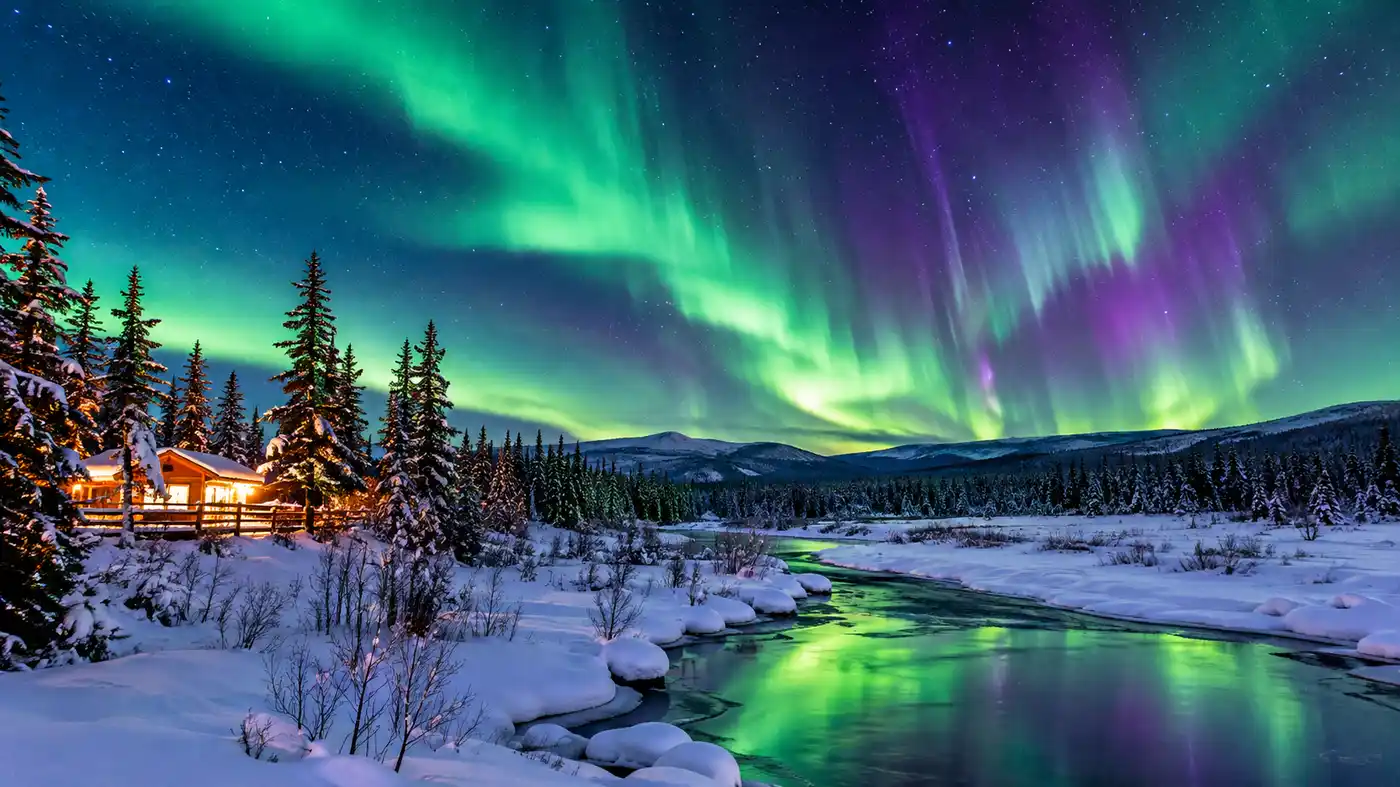
Best Time to See the Northern Lights in Fairbanks
Stand on an icy ridge outside Fox at 1:30 in the morning when the mercury drops past 22 below zero, and your eyelashes will freeze together. You will lose feeling in your thumb just adjusting a camera tripod, but the moment the green curtain starts undulating across the southern horizon, you forget your toes exist. If you want that experience without wasting money on empty skies, pinning down the best time to see northern lights in fairbanks comes down to balancing two stubborn realities: hours of darkness and cloud cover.
Every year, visitors arrive in Alaska with wildly different ideas of how this works. Some book flights in June hoping to watch ribbons swirl over green tundra, completely unaware that midnight looks like midday. Others show up right around New Year's Day, get trapped under four days of dense snowfall, and leave disappointed. Fairbanks sits directly beneath the auroral oval at 64.8 degrees north latitude. That geographic luck gives the city one of the longest, most consistent aurora windows on the planet, provided you schedule your trip inside the right calendar window.
Book your fairbanks northern lights experience:
What Time of Year to See Northern Lights in Fairbanks: Understanding the Season
The official Alaska aurora season runs from August 21 to April 21. That window is not dictated by solar activity. The sun throws charged particles toward earth constantly throughout the year, whether it is Christmas Eve or the Fourth of July. The limitation is simple: daylight.
Between early May and early August, the interior of Alaska basks in the midnight sun. Even at 2:00 in the morning around the summer solstice, the sky glows with a pale dusk. The northern lights can dance above the atmosphere with incredible strength, but your eyes will register only blue sky. Can you see northern lights in Alaska in July? No. You cannot see them in June, and you will not spot them during mid-day in May either. It takes until around the third week of August for true astronomical darkness to creep back into the night sky for roughly 3 hours.
Once mid-August passes, the viewing window expands quickly. By late September, Fairbanks gets nearly 12 hours of night. By the winter solstice in late December, the sun stays below the horizon for more than 20 hours each day. The darkness lingers well into April, when the skies slowly brighten again until the season wraps up around April 21.
If you want to track real-time geomagnetic conditions or read local sky charts before heading out, checking a reliable Fairbanks northern lights forecast will save you from driving miles out onto dark roads on dead nights.
Month-by-Month Guide: Best Month to See Northern Lights in Fairbanks Alaska
Every month inside the season carries its own personality, trade-offs, and weather quirks. Deciding when to visit Alaska to see northern lights depends largely on your tolerance for sub-zero temperatures and whether you want snow-covered landscapes or clear roads.
| Month | Average Night Hours | Average Low Temp (°F) | Historical Cloud Cover | Aurora Potential |
|---|---|---|---|---|
| September | 9 to 13 hrs | 35°F | Moderate (frequent rain early) | Excellent |
| October | 13 to 16 hrs | 18°F | High (snow transitions) | Good |
| November | 16 to 19 hrs | -4°F | Moderate | Very Good |
| December | 19 to 20 hrs | -13°F | Moderate to Low | Very Good |
| January | 18 to 20 hrs | -17°F | Low (cold, crisp air) | Very Good |
| February | 14 to 17 hrs | -12°F | Low | Excellent |
| March | 11 to 14 hrs | -2°F | Lowest (clearest skies) | Exceptional |
| April | 8 to 11 hrs | 21°F | Low | Good (first half only) |
September gives you warm temperatures and the chance to see shimmering green auroras reflected in open rivers and lakes before they freeze over. You can stand outside in a lightweight fleece and watch the sky without worrying about frostbite. The downside is precipitation. Early autumn in the Tanana Valley often brings gray drizzle that sits over the hills for 48 hours straight.
By November, the landscape transforms completely into deep winter. Snow covers the black spruce forests, creating the classic Alaskan postcard. Temperatures fall sharply below zero, pushing air pressure systems into patterns that bring clearer skies than October. December and January deliver maximum darkness, which means you have roughly 20 hours each day where an aurora could theoretically appear.
March is considered by many locals to be the crown jewel of the season. The days warm up enough for snowshoeing or cross-country skiing, while the nights remain bitterly cold and wonderfully clear. Cloud cover in interior Alaska reaches its annual low point in March, removing the single biggest barrier between you and the upper atmosphere.
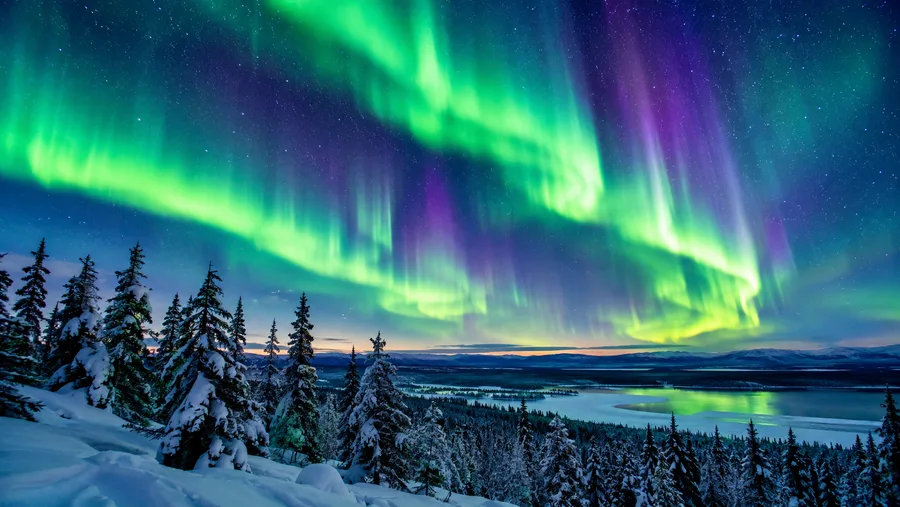
Why March and September Offer the Best Time to See Northern Lights in Fairbanks
Scientists and guides point to the equinoxes as the absolute best time to see northern lights in Fairbanks, and the physics behind it are fascinating. Geomagnetic disturbances hit their annual peaks around the autumn equinox in late September and the spring equinox in late March.
This spike occurs because of the Russell-McPherron effect. During the equinoxes, the geometry of Earth's magnetic field aligns neatly with the solar wind's interplanetary magnetic field. When the two fields connect, cracks open in Earth's magnetosphere. Solar particles flow down those magnetic pathways with far less resistance, sparking bright, dynamic auroral substorms. You can get violent geomagnetic storms from modest solar wind streams that would barely trigger a faint glow in December.
Pro tip: Aim for the two weeks surrounding March 20. You get the benefit of the equinox crack effect, combined with Fairbanks' driest, clearest weather window of the entire winter.
I learned this during a late March trip on Cleary Summit. The local aurora forecast predicted an uneventful KP index of 2. By 11:45 pm, the sky exploded with violet and white spikes that rippled faster than my camera shutter could track, all because of an equinox crack letting modest solar wind punch straight through.
September offers that identical geomagnetic boost, but with unfrozen ground. You can camp, hike during daylight hours, and drive around without worrying about black ice on the Steese Highway. You will sacrifice some dark hours compared to deep winter, yet the 8 or 9 hours of darkness you do get are more than enough to catch a massive show.
Book your fairbanks northern lights experience:
Deep Winter Realities: Viewing Aurora in December, January, and February
Winter in the interior is serious business. When people talk about winter northern lights in Alaska, they often picture bundled-up tourists sipping hot cider by a fire pit. That exists, but so does stepping out of your car into 35-below air that burns the inside of your nostrils before you can finish taking a breath.
Cold air holds less moisture than warm air. That simple thermodynamic rule works in your favor during January and February. Extreme Arctic high-pressure systems lock over the Tanana Valley, dropping temperatures well below minus 20 but scraping the sky completely free of clouds. Stars shine like needle points. If the lights fire up, you see them with zero atmospheric haze.
Photographing and watching the aurora in deep winter requires specific preparation, because the cold drains equipment and human stamina in minutes rather than hours:
- Battery management: Keep spare camera and phone batteries inside your inner coat pocket next to your body heat, or they will die within 12 minutes of exposure.
- Outer layer footwear: Rent genuine Arctic boots rated to minus 40 before heading out to rural ridges, because standard hiking boots will leave your feet numb in half an hour.
- Vehicle care: Never shut off your rental car engine while waiting at remote viewpoints, and make sure your vehicle has an engine block heater plugged in whenever it sits parked at your hotel.
- Tripod mechanics: Cheap plastic tripods shatter when adjusted at 25 below zero; metal ball-heads become stiff and will freeze to bare skin on contact.
Finding a warm vantage point makes a world of difference when the temperatures plunge. Knowing the best places to see northern lights in Fairbanks lets you pick between rustic roadside turnouts and cabins with heated indoor viewing rooms where you can watch through north-facing glass until the display peaks.
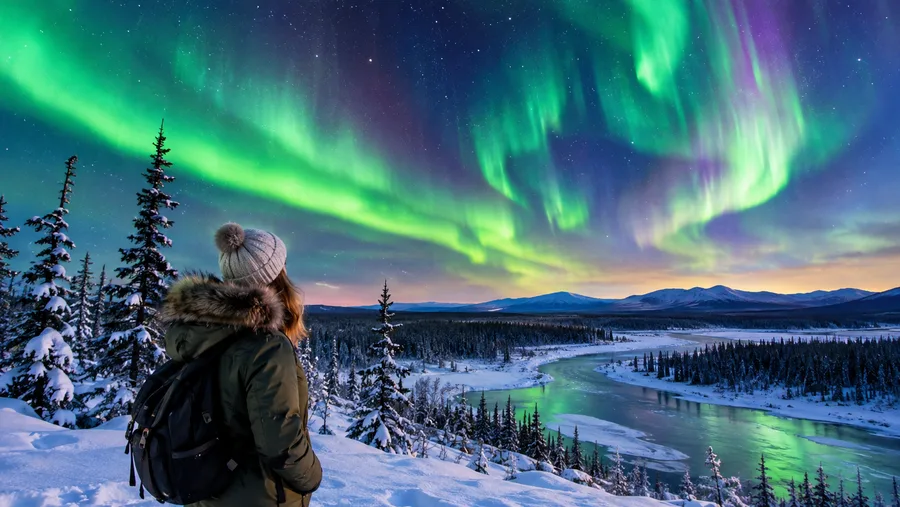
Daily Viewing Windows: Best Time to See Aurora in Fairbanks Each Night
You cannot step outside at 7:00 pm, glance upward for 10 minutes, and cross the northern lights off your checklist. The aurora operates on solar wind and planetary rotation, not human sleep routines.
Across the board, the best time to see the northern lights in Fairbanks on any given night falls between 10:00 pm and 3:00 am. Magnetic midnight in Fairbanks occurs around 1:00 am. That is the exact moment when the Tanana Valley sits directly opposite the sun in Earth's geomagnetic coordinate system. The auroral oval bulges farthest southward right at magnetic midnight, bringing the brightest, most active ribbon displays directly overhead.
Note: Active substorms rarely last all night. A display usually starts as a calm green arc, builds for 40 minutes, erupts into chaotic motion for 15 to 30 minutes, and then dissolves into a pulsating fog.
If you head out to chase the lights on your own, setting up an efficient night routine makes the vigil manageable:
- 9:30 PM departure: Leave Fairbanks and head north or east toward high ground, getting away from the city light dome before the prime viewing window opens.
- 10:30 PM baseline check: Look low along the northern horizon for a faint, milky arc, which is often the first visual indicator that charged particles are gathering overhead.
- 11:30 PM to 2:00 AM core vigil: Stay awake, monitor real-time magnetometers on your phone, and step outside every 15 minutes if you are waiting inside a warm car.
- 2:30 AM assessment: If the sky has dissolved into a dull, patchy green mist that blinks weakly like a heartbeat, the main substorm has ended and you can usually head back to bed.
Patience is everything out here. I have sat in a freezing rental SUV on Murphy Dome until 1:10 am, staring at an empty slate of dark navy sky, convinced the night was a total wash. Then, within 180 seconds, a green ribbon ignited along the western horizon, tore across the zenith, and bathed the snow in eerie chartreuse light for 25 unforgettable minutes.
Frequently Asked Questions about best time to see northern lights in fairbanks
Can you see northern lights in Fairbanks in August?
Yes, but only starting around August 21. Before that date, the sky does not get dark enough to reveal auroral ribbons, even when strong solar storms occur. Late August offers dark skies from roughly 11:30 pm until 3:30 am, along with comfortable temperatures and ice-free roads.
How many nights do I need in Fairbanks to guarantee seeing the lights?
Nothing in nature is guaranteed, but staying a minimum of 3 to 4 nights gives you roughly a 90 percent chance of catching an active display, assuming you actively look during peak hours. A single cloudy weather system can easily wipe out a 2-night trip.
Does the moon ruin northern lights viewing in Fairbanks?
A bright full moon will wash out faint, low-intensity auroras, but it does not ruin moderate or strong displays. In fact, moonlight illuminates the snowy spruce trees and mountains in the foreground, which often makes landscape photography look far better than on pitch-black nights.
Is Fairbanks better than Anchorage for northern lights?
Fairbanks is far superior. Anchorage sits roughly 360 miles south of Fairbanks and sits right on the coast, giving it warmer maritime weather, heavy cloud cover, and location farther from the center of the auroral oval. Fairbanks is inland, much drier, and sits directly beneath the strongest auroral ring.
Quick Reference
- Aurora season: August 21 to April 21
- Peak statistical months: March and September
- Clearest skies: February through April
- Peak nightly hours: 10:00 PM to 3:00 AM
- Minimum recommended stay: 3 to 4 nights
Book your fairbanks northern lights experience:
The Bottom Line
If you want clear skies and deep snow without surviving 40 below zero, book your trip for the middle of March. If you prefer mild weather, open roads, and shimmering reflections on lakes, target the third week of September. Give yourself at least four nights in town, stay up until 2:00 in the morning, and get away from the glow of downtown streetlights. The northern lights will never keep an appointment on demand, but showing up in the right month gives you the best odds anywhere in North America.
Read more about fairbanks northern lights.